

Documenting a Legacy: Producing GEMSO’s 90-Year Anniversary

At DVL Film House, we don’t treat anniversary projects as one-off productions. We approach them as strategic communication initiatives.
GEMSO’s 90-year anniversary required more than documenting an event — it required a structured production process capable of translating decades of history, institutional values, and current operations into clear, purposeful audiovisual communication.
The project centered on a documentary about GEMSO’s institutional narrative and long-term vision, supported by an aftermovie that extends the event’s impact.
Building the Narrative Before the Shoot
Our process began by defining what the 90-year milestone needed to communicate: continuity, institutional strength, and GEMSO’s evolution across industries and generations.
This framework guided every production decision, ensuring each shoot and interview served a clear communication goal.
The Documentary as an Institutional Narrative
The documentary was designed as a long-term communication piece. Instead of functioning as a simple retrospective, it was structured to communicate how GEMSO’s values, technical standards, and leadership culture have enabled sustained growth across sectors such as milling, automotive, agribusiness, and financial services.
From a production perspective, this meant building a consistent interview structure, integrating archival material with present-day operations, and defining a visual language aligned with GEMSO’s institutional tone.
The result is a piece that supports ongoing brand positioning and institutional communication beyond the anniversary moment.
What This Type of Production Requires
Producing content tied to institutional legacy goes beyond technical execution. It requires clear process, narrative alignment, and operational discipline.Structure gives creativity direction — and ensures production functions as a strategic system, not as isolated deliverables.
A Look Into the Production Process
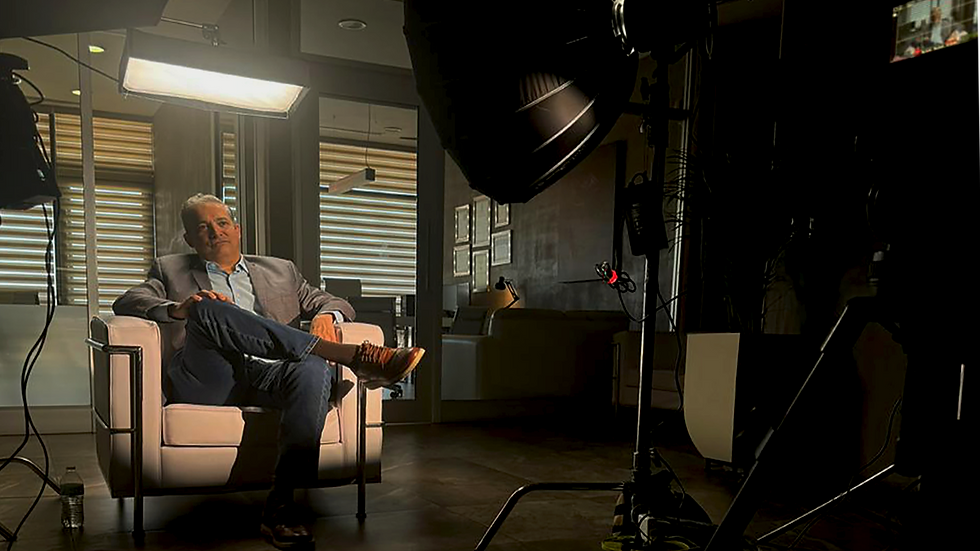
For the documentary, a clear production plan was defined: six shoot days with an eight-person crew.
From pre-production, shared visual criteria were established: a 16:9 format, a color palette aligned with the company’s identity, and an image treatment that balanced wide-scale visuals with closer, more personal portraits.
Interviews were filmed with a two-camera setup, and establishing shots with wide lenses and drone were planned to convey the scale of the operating environments. Archival material was integrated as an active part of the narrative, not just as historical reference.
As a complementary format, the aftermovie captures how the celebration was experienced, key moments from the program, interactions between attendees, and the overall atmosphere of the event, supported by a musical progression that evolves throughout the piece.
These decisions, defined during planning, allowed us to focus the edit on building a clear and cohesive narrative, with a consistent cinematic quality throughout the project.
Which part of this type of process would you like us to explain in more detail?
Let us know your thoughts in the comments.


Comments